James Lee Chiahan + Bryan Beyung
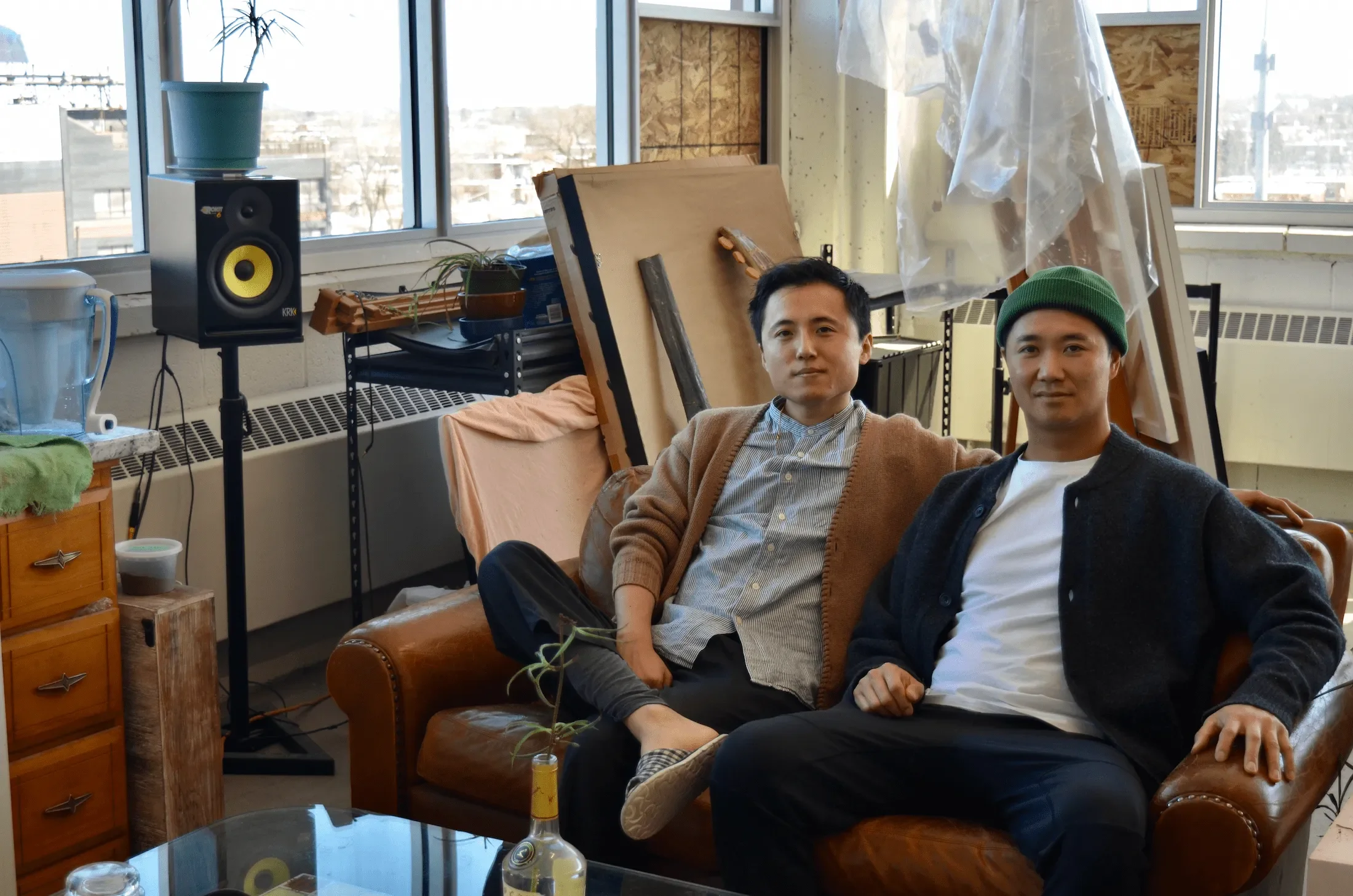
James Lee Chiahan and Bryan Beyung sitting on a couch in their shared studio
Location: Montreal, Canada
For our first dual studio visit, art_works ventured into the shared workspace of Montreal-based artists James Lee Chiahan and Bryan Beyung, where we were greeted with bright sunlight and panoramic views. During our conversation, James and Bryan touched on the value of digital media, the perks of sharing a studio space as a generative social setting, and art's ability to create connections and feed the community.
James Lee Chiahan is a Taiwanese-born Canadian artist, painter, and illustrator whose meticulously rendered works exude a calm familiarity of one intimately acquainted with his subject matter. The results are impressively true to life, each providing a window into diverse channels of the human experience. Bryan Beyung is a muralist and painter born in Montreal to a Chinese-Cambodian family who readily embraces raw lines, abstraction, and imperfections that offset his realistic compositions. Bryan's murals can be seen internationally and throughout Massachusetts, including Boston's Chinatown, Lynn, and Lowell.
-
art_works: So how did you two first meet?
James Lee Chiahan: We were Instagram friends for three or four years. I forget how I found Bryan’s Instagram stuff, or vice versa. But we had been following each other for a while, and were always commenting on each other’s posts.
Bryan Beyung: Commenting emojis, fires. “So good!”
JLC: And then when I moved to Montreal, Bryan reached out to me saying that he saw I was in town, and that we should meet up. “Hey I saw you were in town, we should meet up.” This happened around two years ago, during pandemic times. Bryan reached out to me during a really hard time – my dad actually passed away two years ago. He was near the tail end of it all during the pandemic when Bryan got in touch, so I was in Oakville a lot, the neighbourhood where my family lives outside of Toronto. It wasn’t until about a year later that I was like: “Let’s paint. I’m ready to paint.”
BB: I got James to meet up with me at Parc Frédéric-Back to do some plein-air painting.
JLC: We did that often during the summer, 2-3 times, and got a few paintings out of it. Mostly trees and scenes, a few street scenes around Beaubien with another Taiwanese artist-friend of ours. So that was our story, and it has been true love ever since. A lot of my new friends have actually been found online.
a_w: Have you ever collaborated?
JLC: Although I am itching to start exploring murals, we have only collaborated with graphic design so far. The latest project was for a social center that needed apparel, crewnecks and stuff, so we came up with a few logos for them together.
BB: We came up with a couple of proposals – James was working on some designs, and I was working on my own, and then they got to choose the logos that they preferred.
JLC: We discussed colours, the style and vibe, and then worked individually before bringing our stuff together. No notes from the client, so I think it was a big success. Bryan and I have similar backgrounds – we both went to school for graphic design, and art is self-taught. We are secret designers.
BB: James is better at graphic design. Maybe that is what caught my eye with his work – I could identify with the way that he was shaping his compositions. Even though his works are very painterly and more classical, the way that he structures the compositions is very familiar and influenced by graphic design.
a_w: Do you still work as a freelance illustrator/graphic designer?
JLC: This year, I’ve been really trying to pivot towards visual art, but prior to that since I graduated I tried to juggle both. I worked as a freelance graphic designer and did a lot of work with branding and packaging, like real estate stuff… very different. Which can be nice, since it gives a break from this very art stuff – more structured, there's a client and media problem that you have to solve, whereas with art you are kind of asking questions into the void, more organic and less structured. But this year I am doing a lot more illustration and trying to get this fine art rolling.
a_w: How does digital media influence your art, if at all, or vice versa?
JLC: I haven’t really thought about it that much. I definitely use a lot of the tools and techniques that I learned from design, like photoshopping. Just being able to manipulate images and visuals has helped a lot with my traditional practice. For example, if I get stuck on a painting, I know how to bring it in digitally, and I can really mess with it without breaking the image for real. The two probably train each other in different ways, they are both visually based, they use the same parts of your brain, just looking for patterns and making things make sense.
BB: Let’s say for layout sometimes you would just draw it, or you do everything on the computer?
JLC: Design is more typing in layout, very different, but in terms of compositionally or thinking in terms of hierarchy and stuff like that, colour theory, it all ties together.
a_w: What do you like most or least about sharing the studio space?
BB: Least, you cannot create your own space or world. So when you invite people over, it doesn’t feel like just your space. But that’s about it for me – I see more positives about sharing a space, for now. The rent, for instance. For me, I took this space during Covid, because I was so tired of working from home – I have a studio at home. I felt like we are a social species, and we need to share with other people, even better when through art. Having this space motivates me, especially when James is here, we have similar artist approaches and aesthetics. I feel motivated. Here, there’s more light. It was weird at first, cause you’re putting your work and experimentations out there for everyone to see, your studies, but as a muralist I feel like I was already doing this on a whole other level – super exposed and vulnerable. That is what makes mural-making interesting. It is a similar feeling to that here, but on a smaller scale.
JLC: Exactly the same for me, I worked out of my bedroom forever, and it was only until this year that I came to this studio. Bryan said there was a spot, so yeah, I think it’s the social aspect, having people around to talk with, to have a social exchange of ideas with. Least favourite part, probably also the social aspect. I just get caught up chatting with Bryan, which is nice too – it’s good and bad. Distractions, but good distractions.
BB: I set up here in January of last year.
JLC: And then I came in the fall, closer to October, just for a few months. This space is split up into thirds or chunks, between about nine artists. Painting next to Bryan has been so inspiring. BB: Yeah it has been so great to be bouncing off ideas, he has been showing me a lot of techniques in areas in which he is a lot more experienced.
a_w: What would you say is the one thing you have learned from each other?
BB: One thing I’ve learned from James would be the technical aspect, the way he works with colour, the way that he applies it.
JLC: I got you to clean up your habits. I mean, look at the way his palette was before! Now he uses a glass palette. You were a dirty boy. It was insane, how did you work like that?
BB: Yeah I used to work like I would for my murals, not giving my brushes any love.
JLC: One thing I’ve learned from Bryan is . You’re helping me look at the overall picture and how everything comes together, I tend to get caught up in details. The general feel of working at bigger scales.
BB: It’s funny that you’re saying this, because for me it’s how you work with details. How you are so disciplined working in some spaces. Since I work at larger scales, I have a hard time sometimes at smaller scales, with more details and smaller brushes.
a_w: Tell us about each of your individual practices or processes.
BB: For me, my approach would fall under “autoethnographic,” which means it connects personal experience to wider cultural, social meanings and understanding. Which for me is obviously a diasporic heritage, so I would say most of my works are based on memories, ideas, images from this experience. This is why sometimes I feel like I’m going in different directions, different memories and ideas. This is my foundation. And after that it can be anything – now it is oil paintings, murals but I feel like in the future it could be installations. We will see. For now, it has been four or five years that I have been learning to paint with oil, so I feel like I have a lot to learn and this is what excites me right now. I would love to create immersive spaces.
JLC: I am the same.
BB: Yeah when we first met we really bonded, in terms of image we have a lot of things in common, but also through our personal life – there are a lot of similarities.
JLC: When Bryan was talking about where he draws his ideas from, it is very similar to mine.
BB: Different lives, but similar space. I felt like with some scenes that he painted, I’ve been there. Especially the series of portraits of people sitting around typical Chinese restaurant tables, this is what caught my eyes at first. This guy comes from the same area. Also the treatment of the image, like it is very moody, so a lot of things I learn from him are to use techniques to create mood and ambiance, different layers.
JLC: That is really nice to hear. I think that is something that I strive for, when I create an image, even though I am drawing from my own experience, I work from a lot of photo references that I take or that my family takes, I try to leave it open enough for people to experience it in their own way. They can get their version of it – it doesn’t matter what their version is, as long as the emotional and sensory kind of effect they also get, then I’m happy with it. For me, I say I am much more of an intuitive painter, if I find an image that I’m drawn to and there is an emotional response, then I’ll put it down and that just so happens to be a lot of stuff that comes from my experience.
BB: I also work from photos most of the time – I was trying to let it go a little bit, I like more abstract series, it is more freeing not as tied up or handcuffed to the image. But I feel like with oil painting I wanted to go back to that and really try to capture the feeling or emotion from a specific image. To find something more spontaneous, less tied to the reference image, but I’d say for now I am working with more images and a digital approach to painting, with colours, trying different things.
JLC: It is also really nice to paint from life, to draw directly from life, making studies.
BB: Yeah I’d like to do more of that. Especially painting outside you are more on a schedule, in terms of lighting, weather, etc. You don’t have a full week to paint, it teaches you to be a lot faster.
a_w: What are some projects that you are working on this coming year?
JLC: I am trying to put together a body of work that I can show, so I guess that would be the main big thing.
BB: Same thing for me, I have applied to a couple of projects, we will see in the next couple of weeks or months how those will unfold, but it will be less tied to painting – some are for murals. We actually also have this common project about deps – we want to make a booklet of illustrations, photographs and paintings and writings, it is a collaboration between me, James and a young writer Ange. It depicts this diasporic heritage through the eye of a convenience store owner of Hochelaga, which is the parent of Ange. Dépanneur Populaire Wo? It is in Hochelaga and what we want to depict is the interaction between this owner and the world. So this is one direction that we want to go. Trying to find a way to communicate this really personal story. From there, there will be a show that will happen in the depanneur. So this is why I want to try something that is more immersive. My main focus will be to get a body of work to show very soon. And then the mural season is coming.
a_w: What has been your favourite mural project?
BB: It would be a project in Ville Saint-Laurent, in Arrondissement Saint Laurent, it is a mural that I painted in the neighbourhood where I grew up, for social housing and it is called Norgate and it is a point of entry for newcomers. So there is a lot of movement, rotation, because people go there but don't want to settle in that area. But it is a very lively area – my grandmother still lives a block away from the mural, they gave me carte blanche, so it was very nice. I painted an image of kids at school (the school right behind the building) and all the kids are smiling, but they were just smiling because they were on their way to “semaine de relâche” so that’s why they were so happy. This was a good direction of doing something tied to the neighbourhood and less decorative. Has meaning, une certaine démarche. For this project, it was the approach that made me pick this one as my favourite. I do about 20 public murals a year, but private I do so many more. And before doing this thing, doing more professional, I did a lot of commissions tied to the client’s vision, but that isn’t so much the path I would want to take.
JLC: I would love to try my hand at murals. What Bryan was saying about being able to create art that is important to people who live where the art is and to be able to touch those kinds of relationships, I think that is very interesting to me.
BB: It is out there for people to see, it isn’t hidden away, you don’t need to pay an entry fee, it is out there and accessible for everyone to see and to judge, also. Which can be scary sometimes. The responsibility you feel to paint something that is authentic to you but also can benefit the community and neighbourhood more generally.
JLC: Bryan, you were telling me how in Morocco you were painting and would have random strangers come up to you to talk to you. Just getting the chance to make connections with people on the street is really appealing to me. To actually get involved with what is going on.
BB: Morocco was also one of my favourite mural projects – the Jidar Festival, which is a whole sense of community and festival. We would eat with the organizers every night, and with the team. And people would come over every day and cook food by the mural, they would bring a gas stove and everything. So that experience was also amazing.
JLC: I would have so much to learn from Bryan.
BB: I don’t even think so, it is just your work on a bigger scale, you would just need bigger tools. And you have to get used to things drying quickly in the sun, in the heat. Here in the studio, we paint with optimal conditions, you have water, AC, heating, etc. Compared to being exposed to the elements. It is also very physical work too.
a_w: Where do you find yourselves drawing influence from the most?
JLC: Well right now I’ve been looking at a lot of landscape paintings, I am working on a landscape piece for an illustration, so I have been really drawn to this guy Arkip Quincy, an old dead Russian painter who was incredible. Just him so far. But yeah I don’t know, there are a few mainstays that have been influential for me, there’s Hurvin Anderson, Jennifer Packer, Nicolas Ruib ?.
BB: There are too many for me to choose from. For me it’s more looking at how some artists can do more with less brushstrokes. I think that’s something that has been really inspiring me – to depict an image, but with less work. I mean not necessarily less work, cause you still have to think about how to shape everything, but just the idea of using just a couple of brushstrokes to get the idea and bring it to life, instead of always reworking. I feel inspired by this approach that is more simplified.
a_w: It has been so great to learn more about each of your processes!
BB: Well we are also learning about ourselves as we go! So this is what I’m doing, I’m always wondering. This is the great part of writing it down, let’s say for grants or interviews, you have to put words to what you are doing. Doing this really guides me.
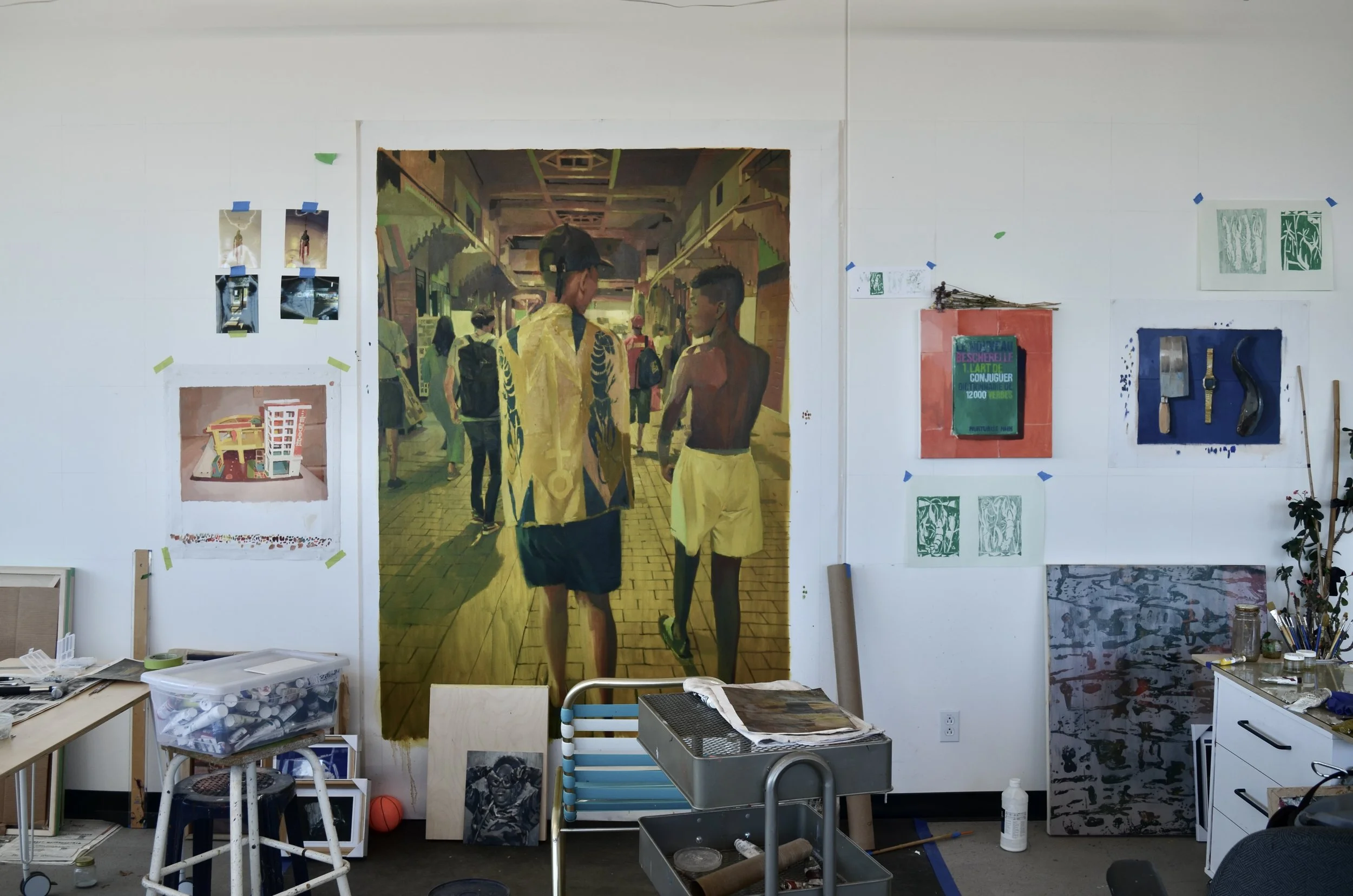
A work in progress by Bryan Beyung
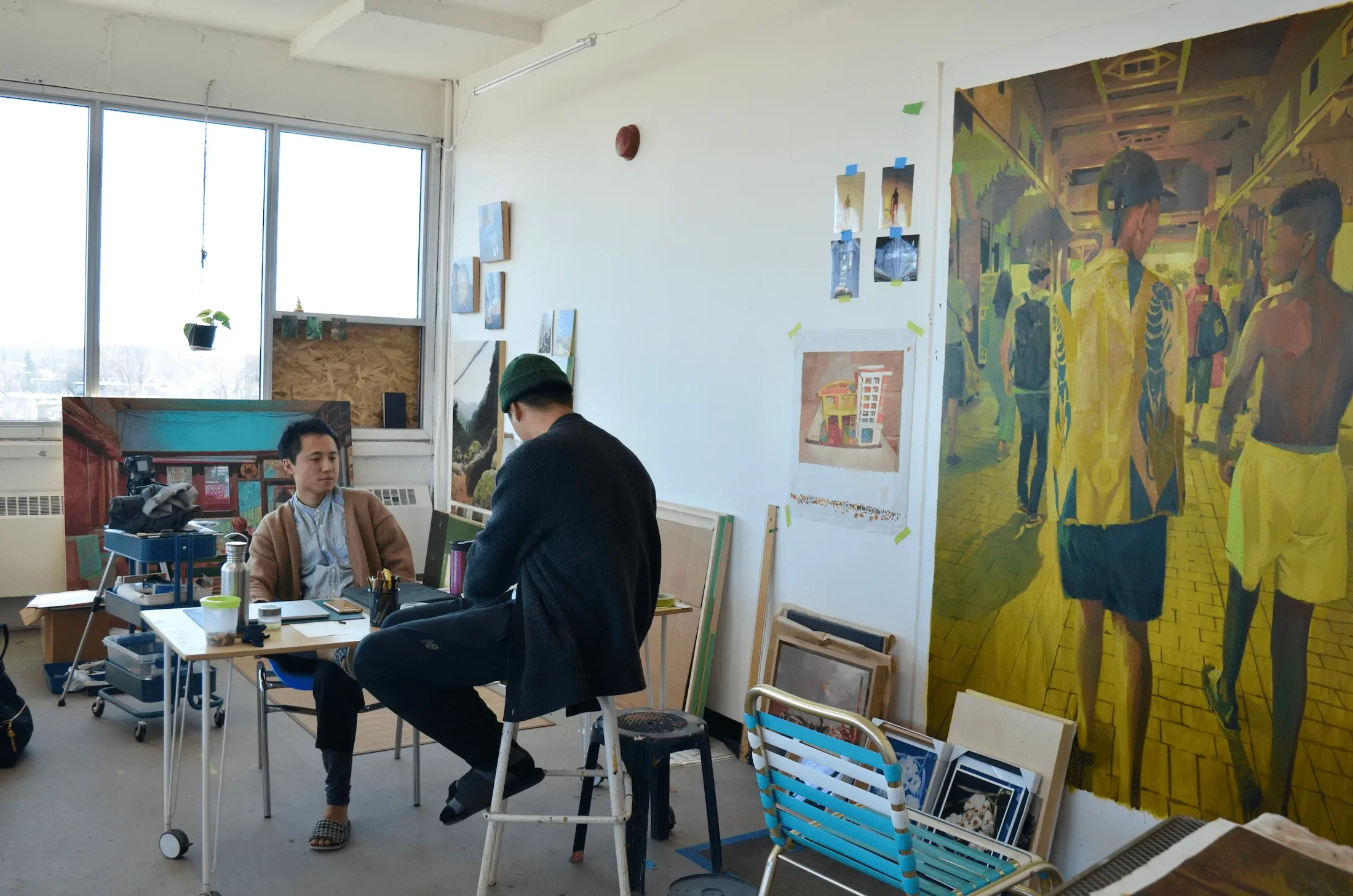
James Lee Chiahan and Bryan Beyung sitting at a desk between their workspace
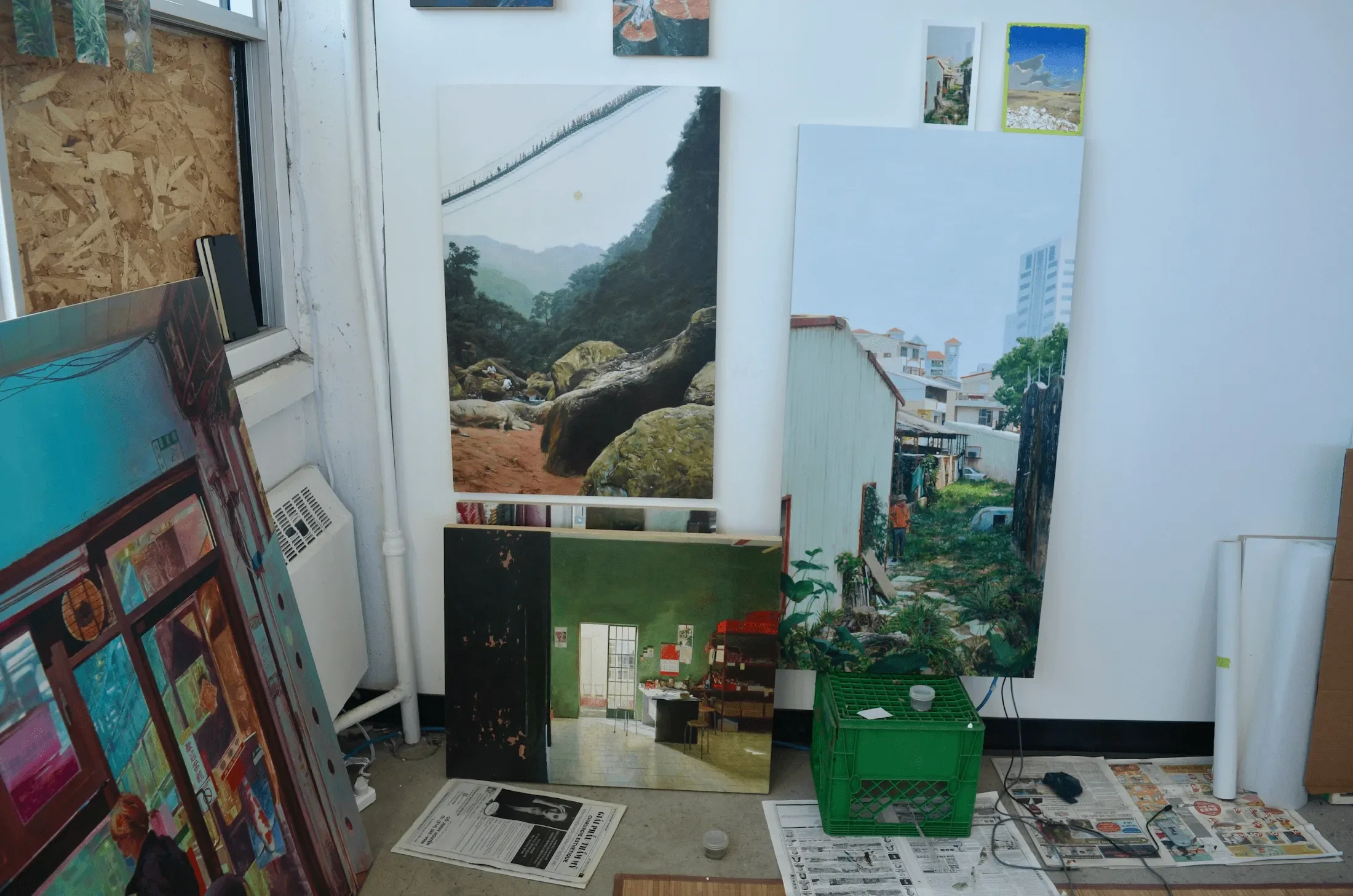
A selection of works by James Lee Chiahan