Small Works, Big Impact
Small-scale sculptures placed in dialogue activate new possibilities for three-dimensional forms in Cambridge, MA.
Photography by Will Howcroft Photography.
Artists: Elise Whittemore, Erin Woodbrey, Alison Croney Moses, Damien Hoar de Galvan
Location: Cambridge, MA
Partners: Confidential Client, Gensler
Artwork:
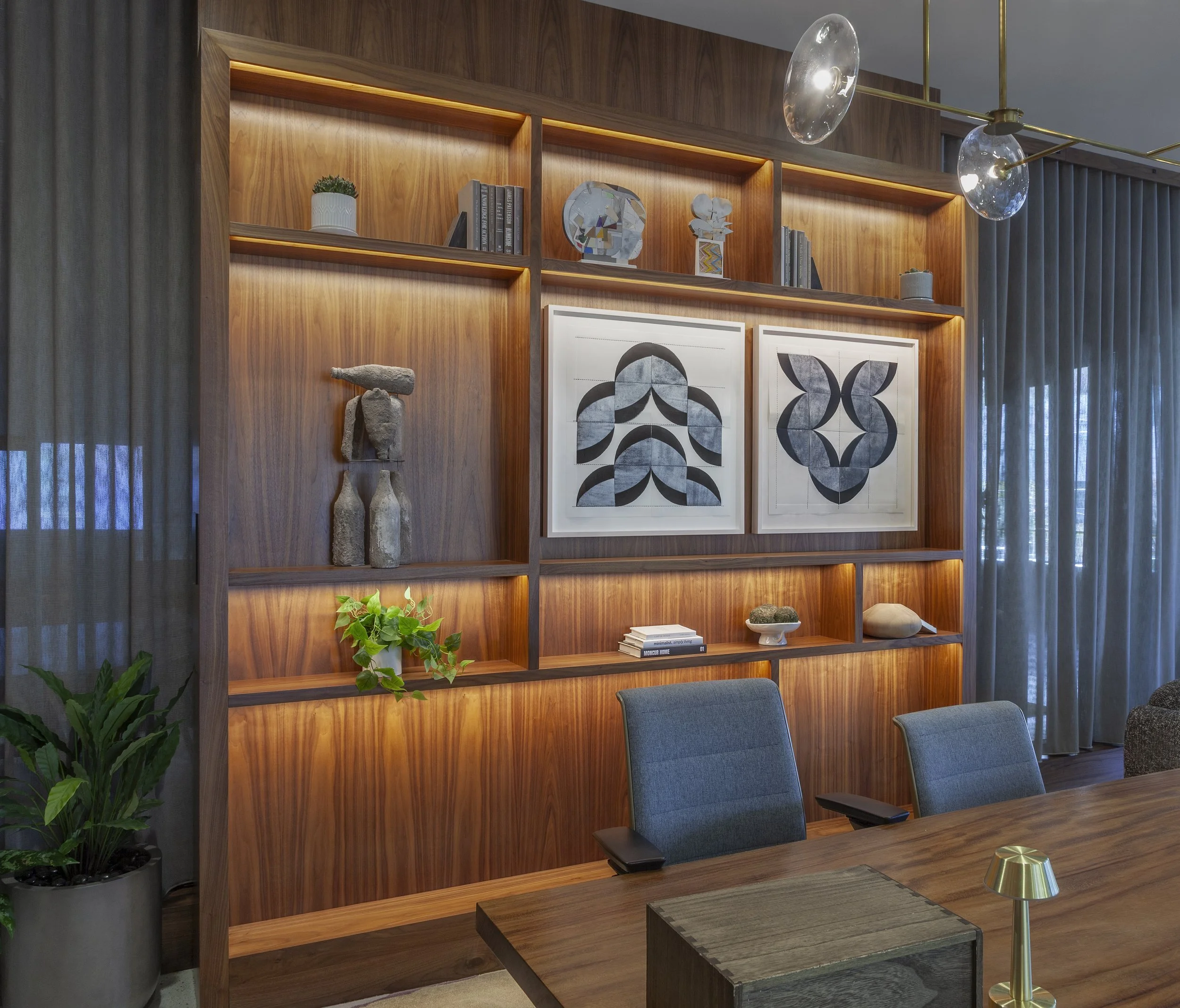
Elise Whittemore, Black Quilt IV& Black Quilt I 2023. Monoprint, soy ink, and cotton thread. © Elise Whittemore.
Erin Woodbrey, The Three Strange Sisters (From the Carrier Bag Series), 2022. Single-use plastic, glass, foam containers, ash, plaster, gauze, and steel wire. © Erin Woodbrey.
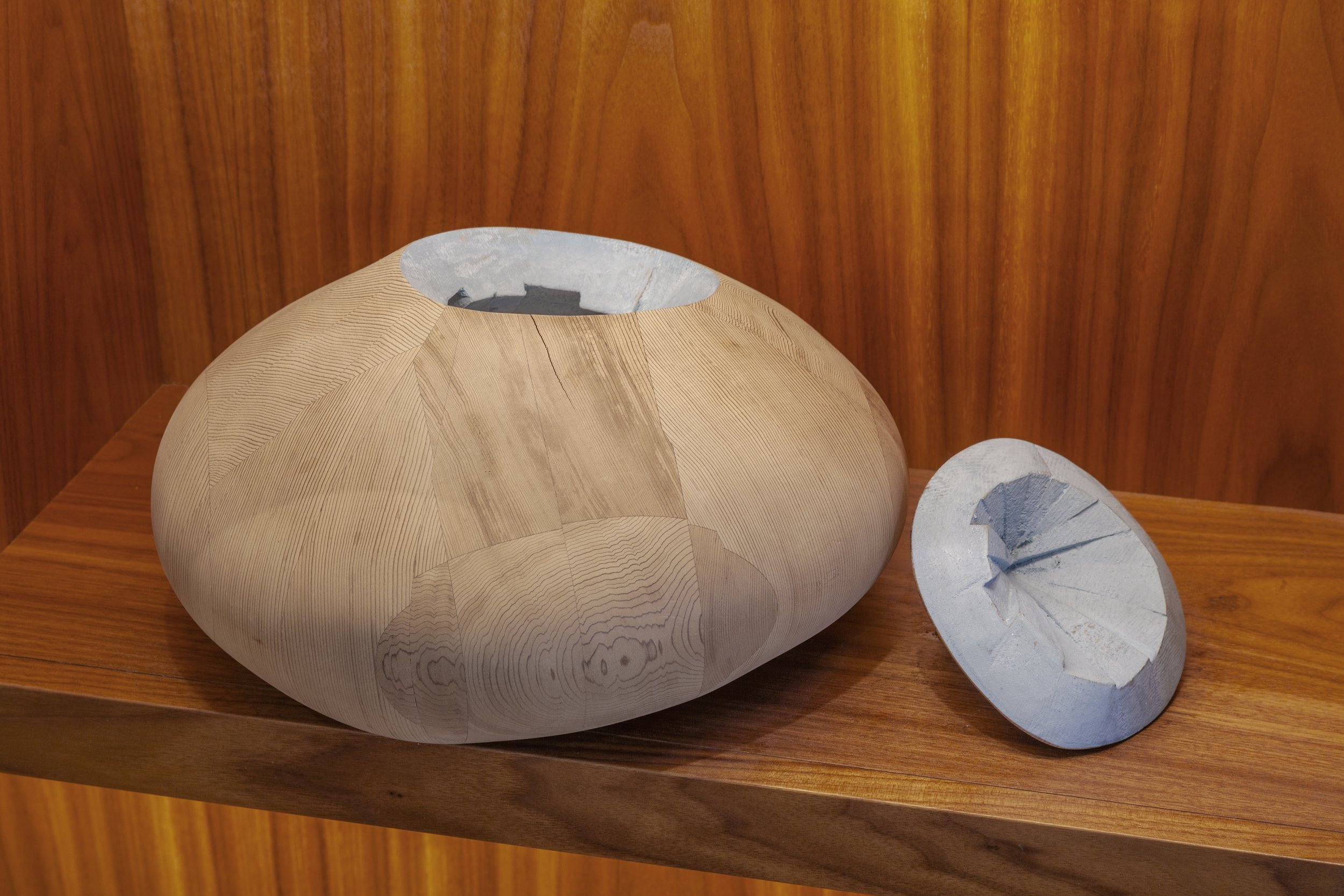
Alison Croney Moses, What We Hold: Pod 3, 2022. Cedar and milk paint. © Alison Croney Moses;
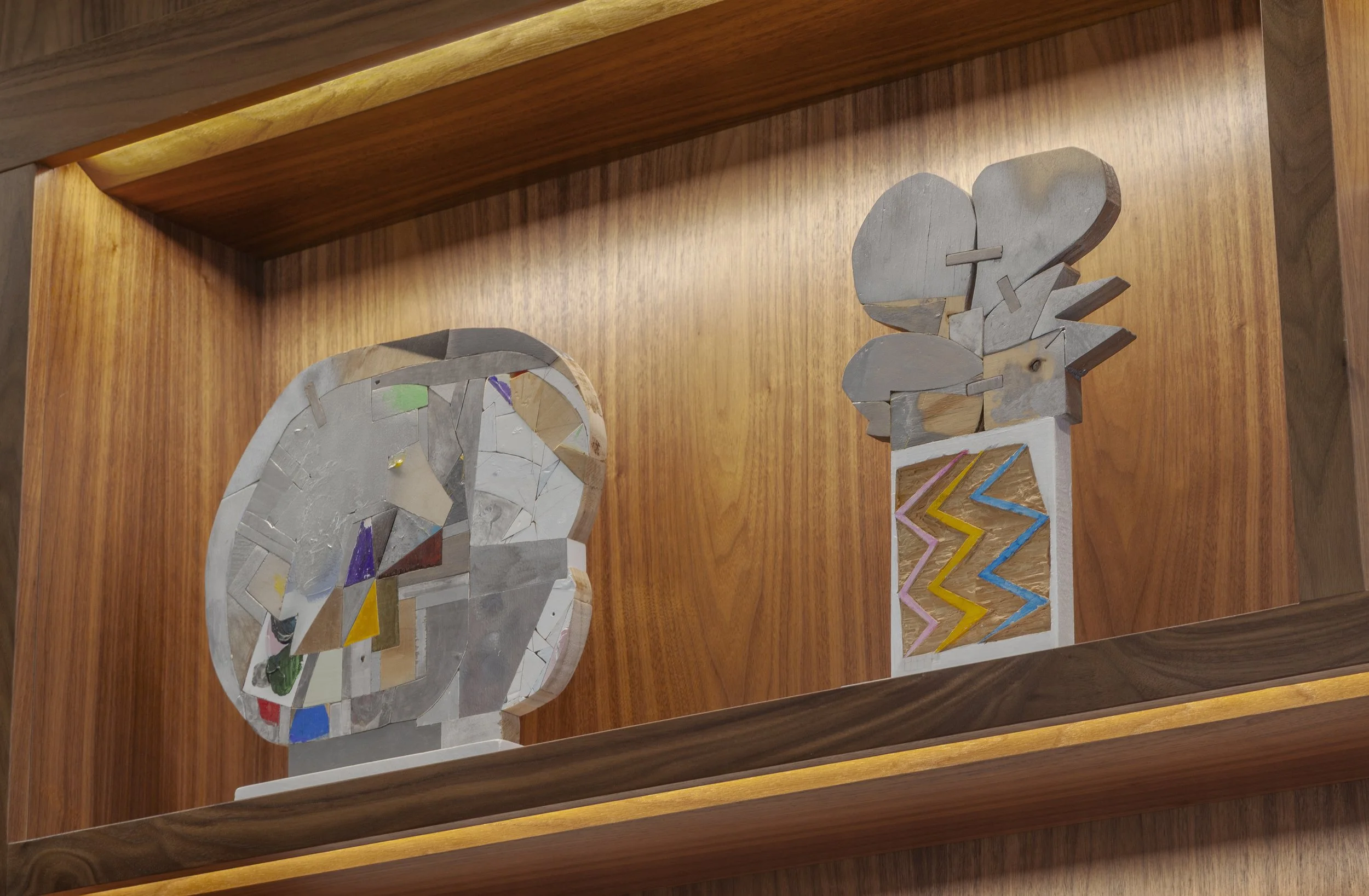
Damien Hoar De Galvan, armor, 2021, wood, acrylic, spray paint, and glue; Zap, 2022, wood, acrylic, spray paint, and glue. © Damien Hoar de Galvan.
Goal + Impact:
In a recent project for a public lobby in Cambridge, MA, art_works explored how sculpture—at every scale—can shape our experience of a space. Inside a central bookcase punctuated by decorative objects, we placed small-scale sculptures by Elise Whittemore, Erin Woodbrey, Damien Hoar de Galvan, and Alison Croney Moses in intentional dialogue.
Together, the work of these four artists creates generative tension—pieced versus poured, preserved versus painted, contemporary color meeting traditional craft. It's the kind of grouping that rewards a second look.
About the artists:
Elise Whittemore (Grand Isle, Vermont) is a painter and printmaker whose work draws on the history of quiltmaking and its tradition of geometric abstraction to articulate ideas of home, identity, and place. She holds a BFA from Syracuse University and pursued further study in woodblock printmaking and lithography at the Art Students' League in New York, as well as painting at the School of Visual Arts. A longtime member of the Vermont arts community, Whittemore has curated exhibitions across the state, taught young curators through Young Curators of Vermont, and received the mid-career Barbara Smail Award from Burlington City Arts in 2017.
Erin Woodbrey (Massachusetts) is a visual artist, gardener, and beekeeper whose interdisciplinary practice encompasses sculpture, installation, printmaking, photography, and time-based media. Working with found objects, salvaged materials, and homegrown matter, Woodbrey weaves together science, mythology, and material cultures across time to examine the existential and socio-political dimensions of climate change. Their work has been exhibited locally and internationally, including at the Boston Center for the Arts, Center for Maine Contemporary Art, Kumu Art Museum in Tallinn, Estonia, and Goethe-Institut Boston, among other spaces. Woodbrey holds an MFA from the School of the Art Institute of Chicago and a BFA from the School of the Museum of Fine Arts at Tufts University.
Alison Croney Moses (Roslindale and Allston, MA) creates wooden objects that reach for your senses—the smell of cedar, the glowing color of honey, the round form that signifies safety and warmth, the gentle curve that beckons to be touched. Born and raised in North Carolina by Guyanese parents, Croney Moses remembers making clothing, food, furniture, and art during her childhood. She cares deeply about why and how things are made, and has carried these values and habits into adulthood and parenting. She creates experiences, conversations, and educational programs that cultivate the current and next generation of artists and leaders in art and craft.
Damien Hoar de Galvan (Milton, MA) has developed a unique output of painted sculpture made primarily from recycled wood for nearly 20 years. His sculptures range from smaller tabletop objects to larger wall-sized installations. Some of the wood Hoar de Galvan uses is reclaimed from his time as a preparator at the deCordova Sculpture Park and Museum in Lincoln, MA, and from his father's carpentry projects, which began in the 1970s after his father immigrated from Massachusetts from Argentina.